
Gen Z will make up 30% of the global workplace by 2030. This is the first generation that is born into technology, and naturally, waiting in a checkout line is far more frustrating to them than it has been for earlier generations. Sustainable retail, therefore, must adapt to its needs.
In a cashierless grocery store, a customer walks in, picks up what they need, and simply walks out without ever needing to stop at a line to have their shopped items scanned one by one. The concept runs on a dense layer of technology consisting of computer vision, AI, sensor fusion, real-time data processing, and a lot more. This tech, unsurprisingly, is expensive.
But is the investment into a cashierless grocery store worth the convenience and business benefits it brings over traditional grocery checkouts? And if it does, how do you adopt it profitably? This article answers exactly that!
What Is a Cashierless Grocery Store?
A cashierless grocery store enables customers to enter the store, get whatever they want, and leave without having to stop at the checkout counter. It does not involve any cashier or point-of-sale interaction.
Instead, their billing is handled autonomously at the exit door by AI technology.
Such stores are also called unmanned, or self-service stores.
Checkout-free retail is a fundamental reimagining of what a physical store is supposed to do. Traditionally, grocery retail has always been organized around a checkout counter.
The first time we heard of checkout-free technology was in the 1990s. Since then, there have been many, many advancements, like scan-as-you-go devices, smart carts, and fully autonomous store systems.
The global unmanned stores market is growing at an extremely fast pace, too! In 2024, it was valued at $66.23 billion, but it is at $103.39 billion in 2026, as per current data. Almost every major grocery chain you can think of, Amazon, Tesco, Aldi, Carrefour, Sainsbury’s, has either piloted or deployed their versions of cashierless retail tech.
How Cashierless Checkout Technology Works
Cashierless checkout technology requires tech of different kinds, i.e., hardware, software, edge computing, and cloud infrastructure, working in coordination.
Here’s a very simplified overview of how it works:
- Ceiling-mounted cameras are installed to keep all of your customers and your products in view from all directions, at all times
- Weight sensors, pressure plates, and RFID tag readers beneath the shelves are used to track inventory
- When a camera detects a user’s movement around the same time and place as a weight-sensor records a decrease in mass at a shelf, your central system cross-validates the purchase.
- Machine-learning models trained on hundreds of thousands of labeled products are used to recognize the products. The average accuracy of the best computer vision systems for instant checkout currently reaches 97% and higher.
- Your customer has an app installed on their phone on which they have a profile and a credit card already on file for billing.
- For back-end integration, you have APIs that connect the cashierless system with POS, ERP, inventory, and loyalty platforms.
Amazon Go and the Rise of Cashierless Retail
Amazon Go was the first to introduce cashierless retail. A team from Amazon executed the concept in 2016 in a 15,000-square-foot mock supermarket inside a rented warehouse in Seattle.
The first store opened to Amazon employees on December 5, 2016, and to the general public on January 22, 2018.
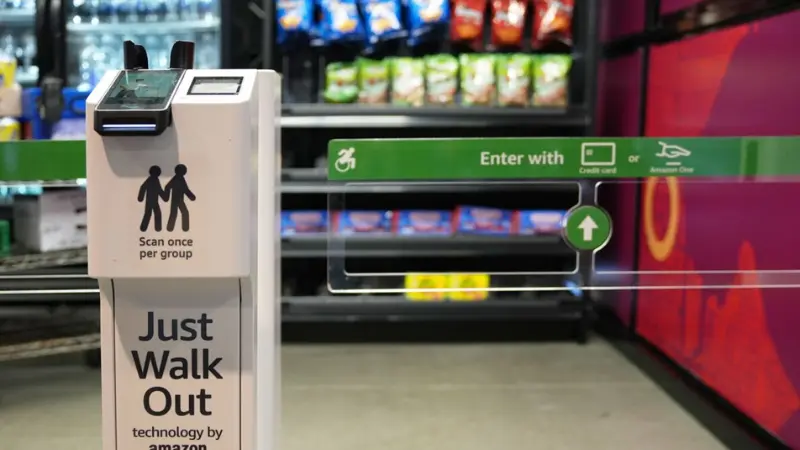
And when Amazon debuted “Just Walk Out” in January 2018, it was described as a “quake moment” for the industry. Just Walk Out is the branded name for Amazon’s proprietary cashierless checkout technology. Here’s how it works:
- Scan the Amazon Go app QR code and tap a credit/debit card, or use Amazon One palm recognition at the entry
- Items you pick up are added to your virtual cart as they are recognized by computer vision tech
- The system auto-charges your linked payment method as you walk out of the exit gate
- A fully itemized digital receipt is delivered to your Amazon Shopping app
The first Amazon Go Grocery opened in Seattle’s Capitol Hill neighborhood on February 25, 2020, with 5,000+ items offered.
Self-Checkout vs Cashierless Stores: What’s the Difference?
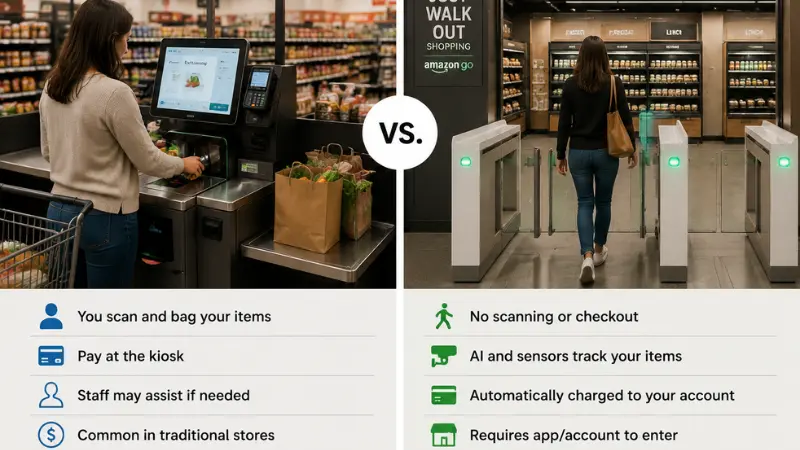
The only thing common between self-checkout vs. cashierless stores is that neither requires a staffed cashier to ring up your items.
Self-Checkout Model
The self-checkout concept was first introduced in U.S. grocery stores in the early 1990s. It is a partial transfer of labor from the retailer to the customer.
It keeps the checkout process in place in the form of payment kiosks, scales, payment terminals, and bagging areas. You just don’t need one-to-one staff assistance. There’s only a supervising staff member who assists customers as they check out.
Cashierless Model
Cashierless retail completely abolishes the checkout process that happens at dedicated counters. In fact, all of the physical checkout infrastructure where you’d scan your items and interact with a payment terminal is removed from the store’s footprint.
The customer’s role in the transaction is also reduced to a minimum. They enter, get the items they want, and leave without having to stop at a physical check-out space.
Key Operational Differences
The table below summarizes the differences between the two models:
| Criteria | Self-Checkout | Cashierless Store |
|---|---|---|
| Customer Action | Manual scanning of every item at a kiosk | None |
| Checkout infrastructure | Kiosks, scales, bagging areas, payment terminals | All checkout hardware eliminated |
| Staff requirements | At least one supervisor per checkout zone | No checkout oversight is needed |
| Investment | Standard POS kiosk hardware | Cameras, sensors, edge computing, AI infrastructure |
| Checkout speed | Faster than staffed lanes | Near-instant |
| Space reclaimed | The checkout area footprint remains unchanged | The entire checkout zone can be converted to retail floor space |
| Implementation | integrates with existing POS infrastructure | Requires a purpose-built layout |
Benefits of Cashierless Checkout for Retailers
Here are some of the benefits of cashierless checkout:
Reduced Labor Costs
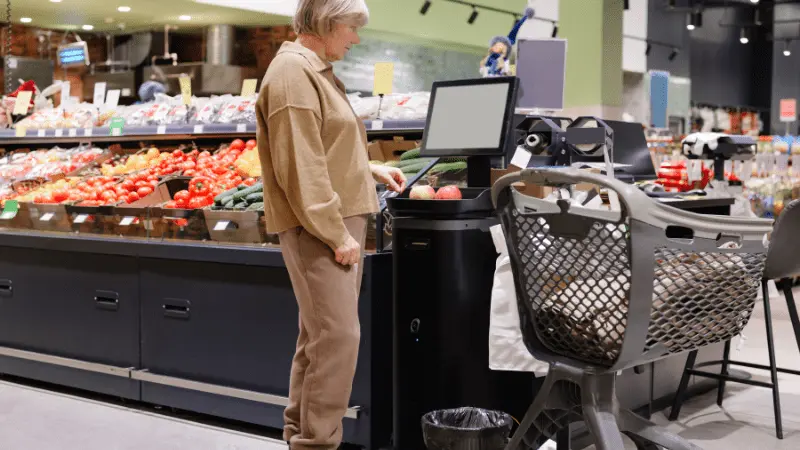
Laborers’ wages are a huge chunk of expense for brick-and-mortar grocery retailers. As of 2024, many U.S. states have set their minimum wage above the federal standards, among which Washington’s rate is $16.28 per hour and California’s $20 per hour for much of the fast-food industry.
Implementing cashierless technology saves about 15–30% in labor costs for retailers. It reduces your headcount required at the POS, and with that, the costs of hiring, onboarding, training, scheduling a workforce, etc.
Faster Customer Flow
86% of consumers abandon a store if the line is too long.
In a cashierless store, multiple people can exit a store simultaneously and be processed by the system in real-time instead of waiting at a checkout counter as it has traditionally been. You make checkout a parallel action rather than a sequential one.
Also, the same physical footprint of your stores can now serve more customers and generate more revenue per square meter.
Higher Basket Size
A customer knowing that a long checkout line awaits them tends to moderate their basket size, consciously or not.
Juniper Research estimated that automated checkout would increase your average revenue by over $300 per shopper per year. Sam’s Club’s real experience in grocery stores was a 27% increase in average basket size among Scan & Go users compared to traditional checkout users.
It is partly because shoppers using cashierless systems can see a running total of their cart in real time. It actually encourages more deliberate purchases.
Improved Digital Shopping Experience
Standing in a queue of a traditional retail store requires a customer to wait and causes the low-grade frustration of watching other lanes move faster. A cashierless system prevents it altogether, which makes the customer experience far better.
You can also integrate personalized loyalty programs into cashierless grocery stores. For example, give your customers targeted offers based on their real-time interactions at the store, very similar to how an e-commerce homepage works in a digital shopping experience.
Such convenience is the primary reason for 83% of consumers to use automated checkouts.
Data and Analytics Opportunities
Cashierless checkout makes every customer’s shopping trip a structured data event for retailers. It gives you detailed info about:
- The items a customer picked up
- The items they put back
- The aisles they visited, or re-visited
- How long a customer spent in each section of a store
- What items were selected together
And so many more insights.
All of that data is very useful for targeted marketing and inventory management purposes.
According to a McKinsey report, AI forecasting for inventory can save you 65% of the sales you’d otherwise lose because of products being unavailable.
The Cost of Cashierless Grocery Technology
Although the benefits of cashierless checkout are very lucrative, you need to know what you can expect in terms of finances to build such a store.
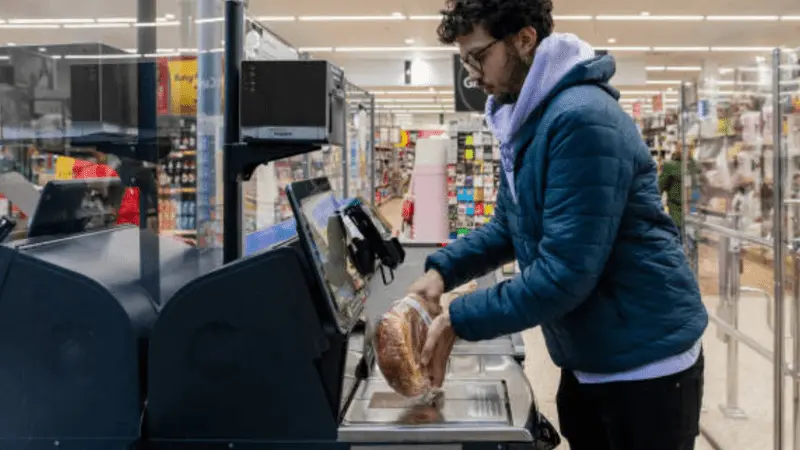
The cost of cashierless grocery technology includes the following:
1. Infrastructure Costs
The most expensive component of your hardware stack will be the depth-sensing, 3D cameras. Individual AI-grade camera units cost between $200 and $500 per unit, but you also need to factor in the costs of installation and power-over-ethernet cabling.
Your store shelves will need weight sensors to confirm if an item was physically removed from the shelf.
Smart shelf sensors cost about $50–$150 per shelf unit. You can add a further $0.10–$0.50 per item for RFID tags of packaged goods.
The data you gather through cameras and sensors needs a networking infrastructure to be processed. On-site server racks, network switches, cabling, electrical panel upgrades, networking equipment, installation, edge server hardware, all of these add to your costs.
These costs are extremely variable. They depend on your store size and the degree of cloud versus on-premise processing you choose.
2. Software and AI Systems
In 2017, the software cost of running Just Walk Out for a year in a 1,000-square-foot store was $4 million. Amazon has reduced it by 96% to approximately $159,000 annually.
By software, I mean the AI models used to identify your products, track the customers, and trigger accurate billing at exit. Besides recurring software and platform costs, you need to be ready to spend on updates.
3. Store Layout Adjustments
Cashierless technology needs a purpose-built store. Even if you do have gated entry lanes, exit corridors, and the turnstile or sensor infrastructure to authenticate your customers at the door, you need to restructure the space of the checkout counters.
Conventionally, 15–25% of total square footage is used for checkout, i.e., checkout lanes, conveyor belts, bagging, the queuing corridors, etc. You will have to demolish it to convert that space into an expansion of your aisles.
4. Maintenance and Operations
The physical infrastructure and software in retail, once installed, come with recurring maintenance costs as well. It is natural for cameras to malfunction or sensors to drift out of calibration.
You can expect to pay about 10–20% of the original hardware cost in annual maintenance contracts for enterprise-grade retail technology systems.
If you license a third-party platform, you will be paying annual subscription fees.
Edge computing hardware needs to be replaced on a cycle of about 3-5 years.
Smart Shopping Carts: A Practical Alternative to Fully Cashierless Stores
A full computer vision system-based, cashierless grocery store comes with an insane price tag. And with that, there’s a very real risk of the vendor shutting down, as happened with Grabango in 2024.
Smart shopping carts are more commercially viable than a cashierless grocery store. They do not require restructuring the entire store with cameras, shelf sensors, edge servers, and networking.
Instead, all of the necessary tech (cameras, weight sensors, a touchscreen, a payment terminal, and edge computing) is part of the cart itself.
A standard smart cart costs around $5,000–$10,000 per unit. If you install a fleet of 50–100 smart, your hardware investment will be around $250,000–$1 million, which is 2–10% of what a fully cashierless store deployment requires.
And your customers don’t need to download any apps. The app requirement for Amazon Go checkout technology was a deterrent for one-time visitors and older shoppers. That’s how smart carts are changing retail checkout for good.
SwiftForce builds smart carts with built-in cameras, weight sensors, touchscreens, and payment terminals, all customizable to fit your store’s layout and systems.
If you’re looking to bring cashierless convenience to your store without the overhead of a full computer vision deployment, get a free consultation from SwiftForce to see what a smart cart rollout looks like for your setup.
The Role of AI Retail Technology in Future Stores
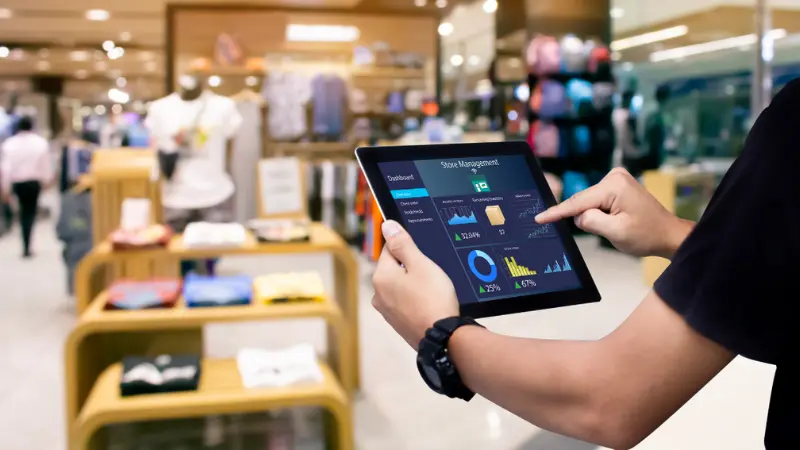
The future retail store is the convergence of multiple AI systems working together.
AI-powered POS systems will go beyond processing transactions, dynamically adjusting pricing, flagging fraud in real time, and feeding purchase data into store-wide intelligence layers.
Computer vision checkout will expand beyond dedicated cashierless zones, also enabling frictionless payment anywhere on the floor.
Meanwhile, automated inventory tracking using shelf-edge cameras, weight sensors, and RFID will feed live stock data to replenishment algorithms.
The result will be a store that continuously learns. Foot traffic patterns inform product placement, purchase behavior refines demand forecasts, and operational data loops back to improve every system simultaneously.
The scale of investment signals just how seriously the industry is taking this shift. The global AI in the retail market is projected to reach $40.74 billion by 2030.
How Retailers Can Successfully Transition to Cashierless Models
Moving to a cashierless store is a phased transformation. Here’s a step-by-step plan for how you can make this transaction:
1. Start With Hybrid Checkout Systems
The least disruptive entry point to get into cashierless models is running traditional and automated checkout lanes side by side. It allows your customers to self-select their experience while staff can observe friction points in real time.
Hybrid systems build internal confidence, surface operational gaps, and let retailers gather the transaction data needed to calibrate AI models before they go fully automated.
They also protect your revenue during the transition because customers who aren’t ready for cashierless options do not walk out.
2. Deploy Smart Cart or Self-Checkout Pilots
Before store-wide rollout, you could test in a contained environment, very similar to how Amazon Go did, for 2 years.
A single store, a defined section, or a specific daypart (such as off-peak hours) will give your team the space to troubleshoot without operational risk.
Smart cart pilots, in particular, reveal how shoppers interact with scan-as-you-go interfaces and flag UX issues that only emerge at scale with real customers.
3. Integrate AI POS Systems
Any transition to cashierless retail depends on a POS backbone capable of handling real-time data from multiple input streams, such as smart carts, computer vision, mobile wallets, loyalty platforms.
Retailers should prioritize systems with open APIs that integrate with existing inventory and CRM infrastructure.
You want to avoid siloed technology stacks that create blind spots in customer data.
SwiftForce’s POS hardware supports Android and Windows, integrates with mainstream payment and loyalty platforms, and is built for the kind of multi-input retail environments this transition demands. You can explore SwiftForce’s POS solutions to find a system that fits your stack.
4. Optimize Store Layout for Automation
Cashierless technology performs best when the physical environment is designed around it.
Optimize your store with wider aisles to accommodate smart carts, and have clear sightlines that improve computer vision accuracy. Make sure you have dedicated entry and exit zones to streamline frictionless checkout flows.
Retrofitting an existing layout is possible, but when planning new locations, you should embed automation requirements into the design from the outset.
FAQs
What is a cashierless grocery store?
A cashierless grocery store lets shoppers pick items and leave without stopping to pay at a register. It automatically charges customers’ accounts for what they get from the store on exit.
How does Amazon Go checkout technology work?
Amazon Go uses overhead cameras, shelf sensors, and computer vision to track which items shoppers pick up. When a customer scans the app, the system builds a virtual cart in real time and automatically charges their Amazon account when they leave.
Are cashierless stores more profitable than traditional stores?
Not necessarily yet. Cashierless stores reduce labor costs but require significant upfront technology investment. If you can invest upfront, it can be a lucrative investment in the long run.
The Future of Grocery Retail: From Checkout Lines to Checkout-Free Stores
Checkout lines have always been one of the biggest pain points in grocery stores, and they haven’t really changed for decades.
Now that is starting to shift. As checkout-free technology becomes more mature, the store is slowly turning into a service space, not just a place to buy things. Instead of waiting in line, customers can spend more time browsing products, trying new items, or engaging with the brand.
At the same time, store staff are no longer limited to checkout work. They can focus on more valuable tasks like helping customers choose products, giving healthy recommendations, or assisting elderly and accessibility-focused shoppers.
AI systems can also turn shopping data into real-time insights, so promotions can be shown at the right moment when customers are most likely to buy.
And younger shoppers are already used to fast digital experiences like one-click ordering and app-based delivery. So they now expect the same smooth experience in physical stores. The retailers who can connect online and offline experiences will be the ones leading the market.
Ready to Move Toward Checkout-Free Retail?
Whether you’re starting with a smart cart pilot, upgrading your POS infrastructure, or planning a fully automated store from scratch, SwiftForce designs and manufactures the hardware you need to make the shift, from POS terminals and self-service kiosks to AI-powered smart carts.
Talk to SwiftForce today and find out how to bring checkout-free retail to your store.