
According to the National Retail Federation, 80% of shoppers say technology makes their shopping experience better. And honestly, it’s not hard to see why. When it comes to repetitive tasks, AI is simply faster and more accurate than people. It doesn’t get tiring, and it’s great at recognizing patterns.
Take fresh food from supermarkets as an example. Staff often have to remember codes for thousands of products—or scroll through lengthy lists to find the right one—while customers wait in line. It’s stressful and time-consuming. The situation becomes even trickier when two items appear almost identical but have different prices, such as different types of apples or tomatoes. That’s when mistakes are most likely to happen.
We can eliminate it with an AI smart POS, which uses a built-in camera to compare what it captures against a trained dataset. It is used to identify the products, weigh them, and apply the correct price in one smooth motion. In this article, I’ll walk through the factors you need to consider before choosing an AI smart POS scale.
What Is an AI Smart POS Scale?
An AI smart POS Scale is, well, as you’d expect, an AI-powered weighing scale.
It’s really an evolution of the basic weighing scales we’re used to seeing at checkout counters. But with artificial intelligence that, along with weighing an item, identifies it too.
Once identified, it can apply pricing and transmit all the transaction data into the point-of-sale terminal.
Conventionally, all a weighing scale has been doing is measure the weight of the object you put on it, and that’s just about it. A cashier has to pick it up and identify what it is (e.g., apples), scan through the codes, find what it’s priced at, and log that data into the system.
AI POS systems require none of that! It has an inbuilt camera (or, fancily known as an object identification system) that takes into account the color, texture, size, number, and all other visual details it can capture.
The info is compared against the data it has been trained on, pretty similar to any AI system you know of, which helps it identify the product.
How AI POS Scales Work in Supermarkets and Fresh Food Stores
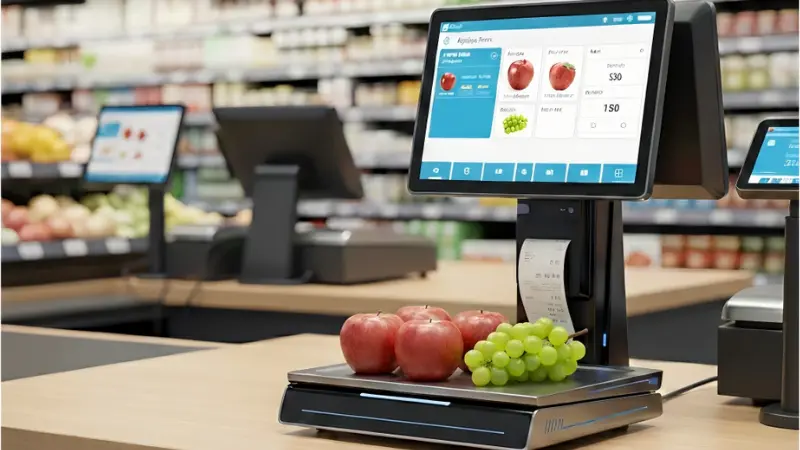
Quite similar to the traditional scales, but with many added functionalities. Here’s how it works.
AI Product Recognition & Weighing
There have always been problems at fresh food stores that traditional systems never solved.
Put one variety of apple next to another, and to an average eye needs a moment of full focus to tell them apart because they’re so similar. All while a line of customers waits behind the staff as they figure it out!
Smart POS scales for fresh food stores come with product recognition tech. The camera attached to the system takes its pictures from different angles to accurately catch all the colors and textures.
The images, if we continue with our apples example, get compared with pictures of all the 100+ commercially cultivated types of apples until a match is found. This is happening at a rate faster than the time it takes you to blink, by the way.
After identification, the system searches for the pricing saved into the POS for the particular variety of apples, multiplies it by the weight it has measures, and there you have an invoice!
Checkout Efficiency and Labor Savings
If you’re working with a weighing scale conventionally, every weight item needs to be followed with a decision, a tap, a confirmation, scanning for codes, entering weight values into POS, and then you get to the invoice.
Count the number of actions. No matter how small they are, but at every step, there is always some room for human error.
Now imagine what happens during rush hour. The same scenario, but staff are now expected to work at a much faster rate. A wrong tap at one place and you either end up with inadvertent loss or you need additional time to fix it up, if you’re lucky enough to catch it in time.
Smart POS scales remove all these speed bumps. You don’t need a staff member to read up numbers on the weight scale and enter them on the POS.
In fact, you save your staff members from the pain of telling all the 100 varieties of apples apart! Their work becomes much less cognitively draining. And of course, you move more customers through checkout without adding more hands on the floor.
AI POS Scale vs Traditional Weighing Scale
Take a quick glance at the differences between the AI POS scale vs traditional weighing scale.
| Category | AI POS Scale | Traditional Weighing Scale |
|---|---|---|
| Product identification | Camera-based recognition | Manual |
| Speed | Higher | Slower when lines grow |
| Accuracy | More consistent | Depends on staff attention and training |
| Inventory impact | Clean records | Inventory drift is common due to wrong selections/skipped entries |
| Training burden | One-time system training | Staff must learn PLUs and categories |
| Dual display | Yes | No |
| Hardware components | Scale, camera, compute module, display, networking | Scale, basic display |
| Internet/network requirement | Needs stable LAN/Wi-Fi for POS sync | Can works offline |
| Upfront cost | Higher | Lower |
| Best fit | Busy fresh supermarkets with high SKU variety | Small shops |
Key Functional Differences
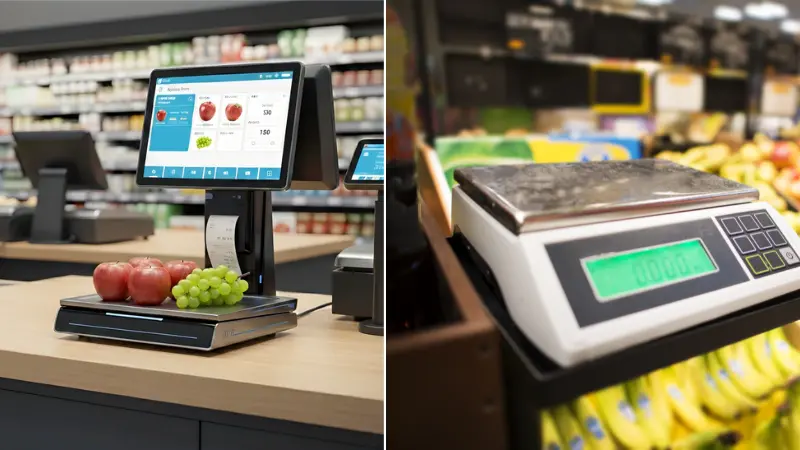
The only function that a traditional weight scale and a smart AI-powered one share is the ‘weighing’ bit.
Weighing scales need a staff member who will reach for the PLU and scroll through product categories until they find the one they see on the scale. Or, they will have to recall a code they learned in training some time ago.
There’s no place for this step in an AI-POS system. The items placed on it get auto-recognized by the system and the workflow proceeds towards the transaction.
During busy hours, the workload on your staff members is amplified way too much because they must catch up with the increasing number of customers waiting in line for checkout. But if a store uses an AI smart POS scale at the counter, there’s really no additional burden on the staff.
Manually figuring out the differences between similar-looking products can lead to a lot more errors than getting an AI system trained on images to tell them apart.
Cost Comparison
Traditional hardware is cheaper upfront. A basic weighing scale will cost you only a fraction of the AI POS scale.But if we take into account the costs of AI POS scale vs traditional weighing scale over, let’s say a 10-year duration, a cost-value analysis for a traditional system is not the best!
Add in the amount you save up with an AI POS scale that would otherwise be missed simply because of human errors (mislabelling, misreading, etc.).
Also factor in the additional number of customers you can now facilitate because the average time to entertain one customer is greatly reduced with an AI workflow.
You also need fewer hands to move the same number of customers, so the cost of hiring and training new staff members is reduced.
Key Features to Look for in an AI Smart POS Scale
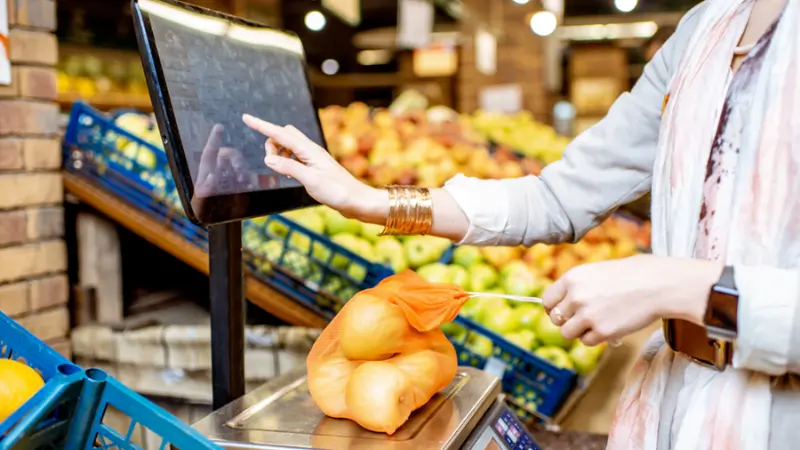
Before you go make that big purchase, make sure you consider the following factors:
- The scale should distinguish between similar items with accuracy.
- It should send the product and pricing data straight into the checkout without any manual input.
- The display should be large enough to be visible at a distance.
- The hardware should be built with strong materials.
- The AI POS scale hardware supplier must be dependable too. You can’t do much with a system without professional supplier support.
How to Choose the Right AI POS Scale for Your Store
Besides the key features discussed above, you need to look into certain other factors too, as you go towards making that purchase.
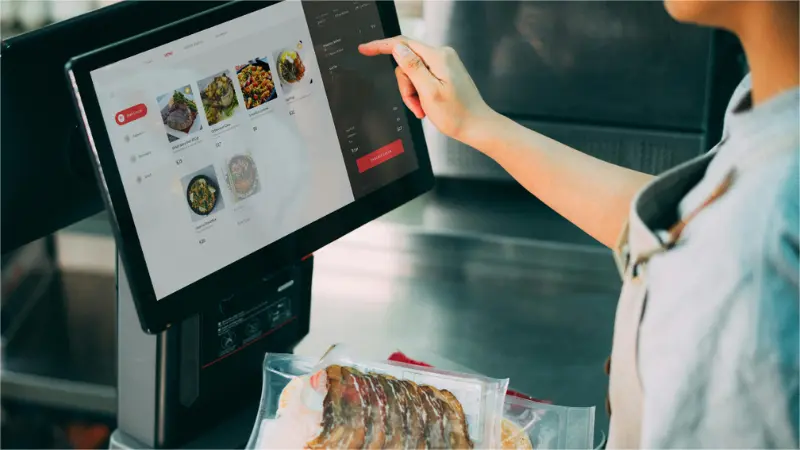
A specialty shop with a limited range of fresh items probably does not need a fancy AI POS setup as much as a high-volume supermarket does that handles hundreds of SKUs every day.
Consider the costs you’ll put into the purchase and form a rough estimate of what you’ll save up. Do not make your decision solely on the basis of upfront costs.
Get your hands on one that doesn’t require niche technical expertise to operate otherwise, training costs will eat up a lot of your budget.
Also, think of the future when choosing a POS scale. The system should have the means to update regularly as AI capabilities improve, so your investment doesn’t age out.
Benefits of AI POS Scales in Retail
The most obviously visible benefit you get from AI POS scales is the efficiency in your workflow. AI integrates the checkout time so much faster because of its auto image recognition.
We’ve also talked quite in detail about how they reduce errors you’re very probably bound to get with manual weighing scales. The consistency in the workflow doesn’t even require any additional effort on your end.
And since the same manpower is no longer needed moving transactions through, you also get to save up on new hiring and training.
Speaking from the staff members’ end, their job becomes a lot less draining.
All you want in retail is a smooth customer experience, and all the other benefits directly end up doing exactly that!
ROI and Cost Considerations

You’ll likely get a sticker shock when you find out about upfront installation costs for AI smart POS scales. Traditional scales cost much less and are therefore an easy-to-justify investment.
But we must evaluate your ROI on both first.
As we’ve seen, smart weighing and automated transactions reduce the need for constant staff involvement. Employees don’t have to memorize product codes or stop what they’re doing to fix small checkout issues.
Over time, this makes a real difference. Each transaction takes less time, staff spend fewer hours handling repetitive tasks, and operations run more smoothly. Within just a few months, those saved labor hours can help cover the initial investment cost.
There are AI POS systems suited to the needs of both large-scale and small-scale supermarkets.
XiaShang Supermarket is a chain of more than 200 fresh supermarkets and community convenience stores. It introduced AI POS terminals with 99% recognition accuracy and an average weighing time of 3-5 seconds. Their large-scale systems had dual-sided dot matrix LCD displays through which both the operators and customers could see the weight and pricing.
In a very different market, i.e., Pakistan, where street-level fruit and vegetable shops form the backbone of daily food access, an AI scale was introduced on a very small scale. The model was trained on a dataset of 2,622 locally sourced images upon which the system reached 98 percent precision.
The point is, supermarkets of all sizes have a lot to improve if they access the AI POS system built for their requirements.
FAQs
What is an AI smart POS scale?
An AI smart POS scale is a weighing device used to identify products placed on it, weigh them, calculate prices, and send transaction data to the point-of-sale system.
How does an AI POS scale improve checkout speed?
It automatically prices an identified product the moment it is placed on the scale. You cut down on the time taken by staff to retrieve the codes for products and log them into the system for it to calculate the price.
Can AI POS scales replace traditional weighing scales?
Absolutely! They perform the same job as the traditional scales but with added benefits.
How much does an AI POS scale cost for a supermarket?
You’ll find AI POS scales between the range of $300–$1,000, depending upon the differences in their features.
Which AI POS scale features are essential for fresh food stores?
An AI POS scale for fresh food stores should be accurate, have a fast processing time, integrate into the POS, and have a dual-view display. Bonus points if it comes with a self-checkout feature!
Conclusion
Why would you keep asking staff to memorize codes and slow down your customer checkout lines when a system can handle the same pressure more reliably?
AI smart POS scales are no longer a “nice to have” — they are becoming essential infrastructure for modern supermarkets. They reduce checkout friction, improve pricing accuracy, minimize shrinkage, and support higher transaction throughput during peak hours.
Most importantly, they protect the customer experience. In a competitive grocery landscape, shoppers will always gravitate toward stores that offer speed, convenience, and reliability.
CTA
At SwiftForce, we design and deliver intelligent POS and self-service hardware solutions tailored for modern retail environments. Our AI smart POS systems combine precision weighing, seamless checkout integration, and scalable deployment support.
If you’re evaluating how AI-powered POS technology can improve your store operations, we’re ready to help. Speak with our experts today to discuss your store format, pilot goals, and deployment plan.
Let’s build a faster, smarter checkout experience together.